Lending Insights

Skills
Platform Redesign, UX Testing/Interviewing, Project Management
Timeline
Aug - Dec 2025
Class
Experience Studio Four

Project Overview

Lending Insights is Allied Solutions business intelligence platform designed to give financial institutions (primarily credit unions) powerful tools for understanding and managing their lending operations.

Our goals are centered around Reimagining the legacy reporting experience into a modern AI-enhanced system, empowering users to build/customize reports independently.

Process

Problem

Users struggled to create custom reports due to:

  • Unclear and repetitive filter labels

  • Confusing, identical-looking sections

  • No feedback when filters were applied

  • Overwhelming interface with cluttered icons and fields

  • Limited ability to customize or edit visualizations

  • Outdated, hard-to-manage saved reports

  • Frequent reliance on internal support to complete tasks

Goal

Our goal was to redesign the reporting experience so lending teams could easily customize data and visualizations, understand filter behavior, and see changes clearly throughout the process. We aimed to make report creation more flexible, enabling users to edit, compare, and save their work without restarting. Ultimately, we wanted to empower teams to work independently rather than depend on support staff.

Key Outcomes

Our redesign delivered a clearer, guided reporting flow with a simplified filter structure and more meaningful labels. Users gained improved visualization customization and editing, along with a modernized saving and report-management experience. Most importantly, the human-centered narrative helped stakeholders deeply understand the real user challenges, building alignment around our solution.

We also explored the impact AI could have on the custom reporting process. Shown below is how our final workflow incorporates those features, all while asking the user permission to use their data safely.

Problem

Users struggled to create custom reports due to:

  • Unclear and repetitive filter labels

  • Confusing, identical-looking sections

  • No feedback when filters were applied

  • Overwhelming interface with cluttered icons and fields

  • Limited ability to customize or edit visualizations

  • Outdated, hard-to-manage saved reports

  • Frequent reliance on internal support to complete tasks

Goal

Our goal was to redesign the reporting experience so lending teams could easily customize data and visualizations, understand filter behavior, and see changes clearly throughout the process. We aimed to make report creation more flexible, enabling users to edit, compare, and save their work without restarting. Ultimately, we wanted to empower teams to work independently rather than depend on support staff.

Key Outcomes

Our redesign delivered a clearer, guided reporting flow with a simplified filter structure and more meaningful labels. Users gained improved visualization customization and editing, along with a modernized saving and report-management experience. Most importantly, the human-centered narrative helped stakeholders deeply understand the real user challenges, building alignment around our solution.

We also explored the impact AI could have on the custom reporting process. Shown below is how our final workflow incorporates those features, all while asking the user permission to use their data safely.

Problem

Users struggled to create custom reports due to:

  • Unclear and repetitive filter labels

  • Confusing, identical-looking sections

  • No feedback when filters were applied

  • Overwhelming interface with cluttered icons and fields

  • Limited ability to customize or edit visualizations

  • Outdated, hard-to-manage saved reports

  • Frequent reliance on internal support to complete tasks

Goal

Our goal was to redesign the reporting experience so lending teams could easily customize data and visualizations, understand filter behavior, and see changes clearly throughout the process. We aimed to make report creation more flexible, enabling users to edit, compare, and save their work without restarting. Ultimately, we wanted to empower teams to work independently rather than depend on support staff.

Key Outcomes

Our redesign delivered a clearer, guided reporting flow with a simplified filter structure and more meaningful labels. Users gained improved visualization customization and editing, along with a modernized saving and report-management experience. Most importantly, the human-centered narrative helped stakeholders deeply understand the real user challenges, building alignment around our solution.

We also explored the impact AI could have on the custom reporting process. Shown below is how our final workflow incorporates those features, all while asking the user permission to use their data safely.

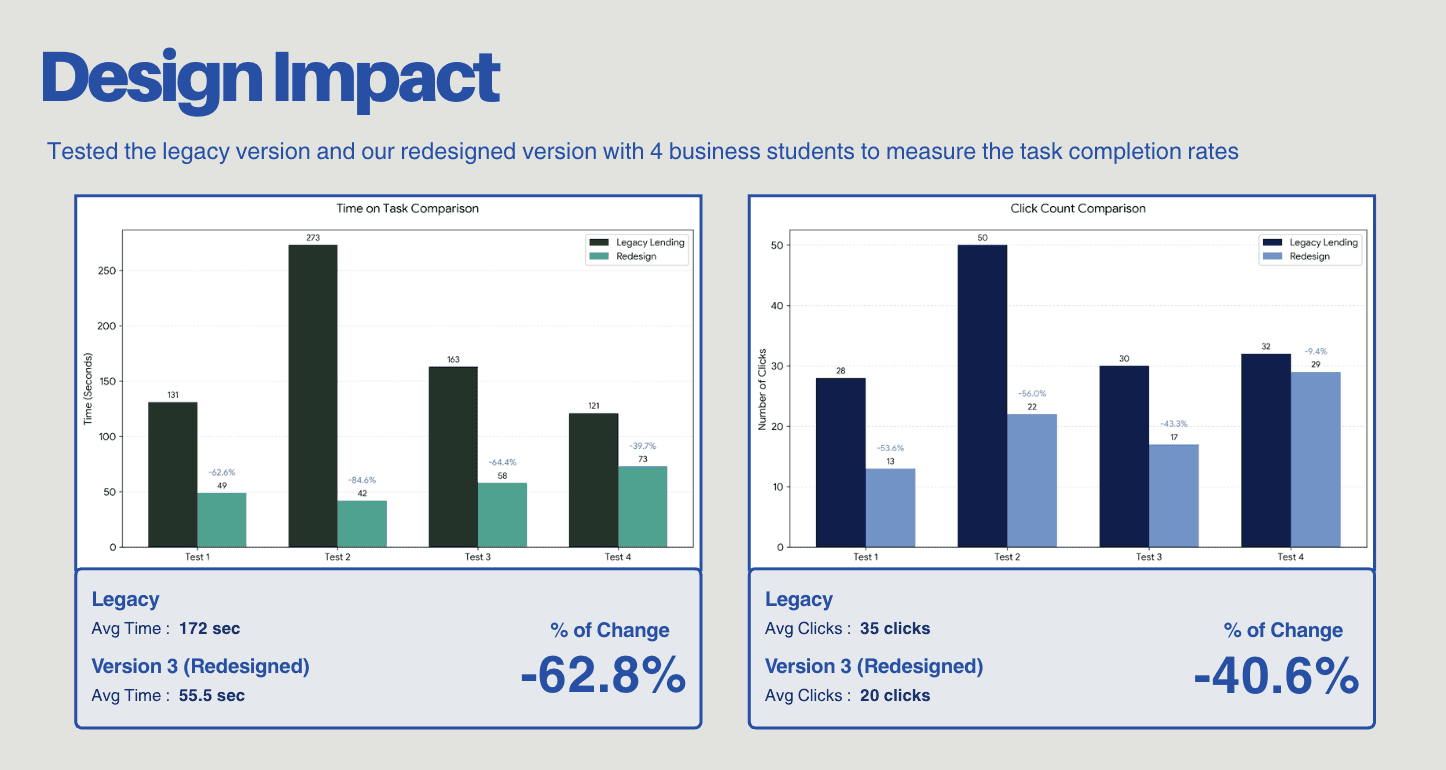
Design Impact

To validate the impact of our redesign and Jason’s new experience, we conducted task-based usability tests comparing the legacy system with our redesigned version. Four business students completed identical reporting tasks in both systems, revealing substantial improvements. On average, users completed tasks 62.8% faster, reflecting how streamlining navigation, clarifying terminology, and structuring the reporting flow made the workflow much clearer. Additionally, users required 40.6% fewer clicks to achieve the same outcomes. These results demonstrate that our redesign significantly reduced cognitive load, creating a reporting process that is more direct, predictable, and efficient.

My Role

For our final presentation, I led the narrative and storytelling, responding to feedback from our midterm that the context around our user and scenario was unclear. I created the primary user persona and scenario, then designed a role-play walkthrough to bring the user journey and pain points to life. I opened the presentation by setting the scene, introduced the persona, and guided the audience through the story. Additionally, I supported research synthesis and UI/UX recommendations, and took on a facilitation role—responding to questions in real time and clarifying our design decisions. This experience strengthened my ability to communicate complex ideas, advocate for the user, and present work in a compelling, human-centered way.

Click the links below to view the full details of the project!

Personal Reflection

Working on the project this semester was a huge learning experience for me, both as a designer and as a leader. From the start, having interned for Allied Solutions this past summer, I stepped into more of a leadership role than I had in past projects, and it really pushed me to grow. I was involved across almost every part of the project, in terms of decision-making, communication, and designing, this allowed me to gain more experience leading a team.

This project gave me a better understanding of how to manage a real-world redesign process from start to finish. I also grew more confident in presenting our work and connecting design choices back to research and testing insights. Overall, the project really helped me see how much I’ve developed this semester in how I approach collaboration, leadership, and user-centered design. I really really enjoyed this project and I have so much to take away from it! Overall, I’m really proud of what we accomplished, and as my last Experience Studio, this project has definitely been one of the most rewarding experiences! It is always a pleasure to work with Allied Solutions, and I am pleased to include this project as a part of my portfolio.

Create a free website with Framer, the website builder loved by startups, designers and agencies.